What is HuntLeague Ballistics?
It is a point-mass ballistic solver — the same class of engine used by dedicated ballistic apps and wind meters. It integrates your bullet’s actual flight using standard G1 and G7 drag models, your muzzle velocity, your zero, your scope height, your barrel twist, and the current atmosphere.
One engine runs everywhere. The DOPE card in the iOS and Android apps, the per-stage firing solutions on the NRL Hunter clock screen, and the Ballistics page on the HuntLeague web portal all share the same solver and the same saved data — and the mobile apps carry an identical on-device copy of the engine, so your DOPE still works offline deep in the backcountry!
What it calculates
- Dial (come-up) — your elevation correction from your zero, in MOA or MIL to match your turret, plus the exact click count for your scope’s click value.
- Wind hold — full-value-corrected for the wind direction you enter on a clock face.
- Spin drift — shown in its own column and folded into the total wind hold.
- Aerodynamic jump — the vertical shift a crosswind causes, folded automatically into your elevation dial.
- Remaining velocity and energy at every distance, with a supersonic/subsonic boundary highlighted.
- Retained-energy guidance — how far your load carries deer-, elk-, and moose-class energy, and expansion-velocity limits for copper/mono bullets.
- Gyroscopic stability (Sg) from your twist rate and bullet, and a full trajectory chart.
Elevation vs. Density Altitude — they are not the same thing
Your GPS says 6,200 ft. Your bullet does not care. What the bullet feels is air density — and air density moves with temperature, pressure, and humidity, not just elevation. Density Altitude (DA) rolls all of that into one number: the altitude the air is behaving like. A 90° afternoon at 6,200 ft can shoot like 9,000 ft; a freezing morning at the same trailhead can shoot like 4,500 ft. That swing is real dial-money at distance.
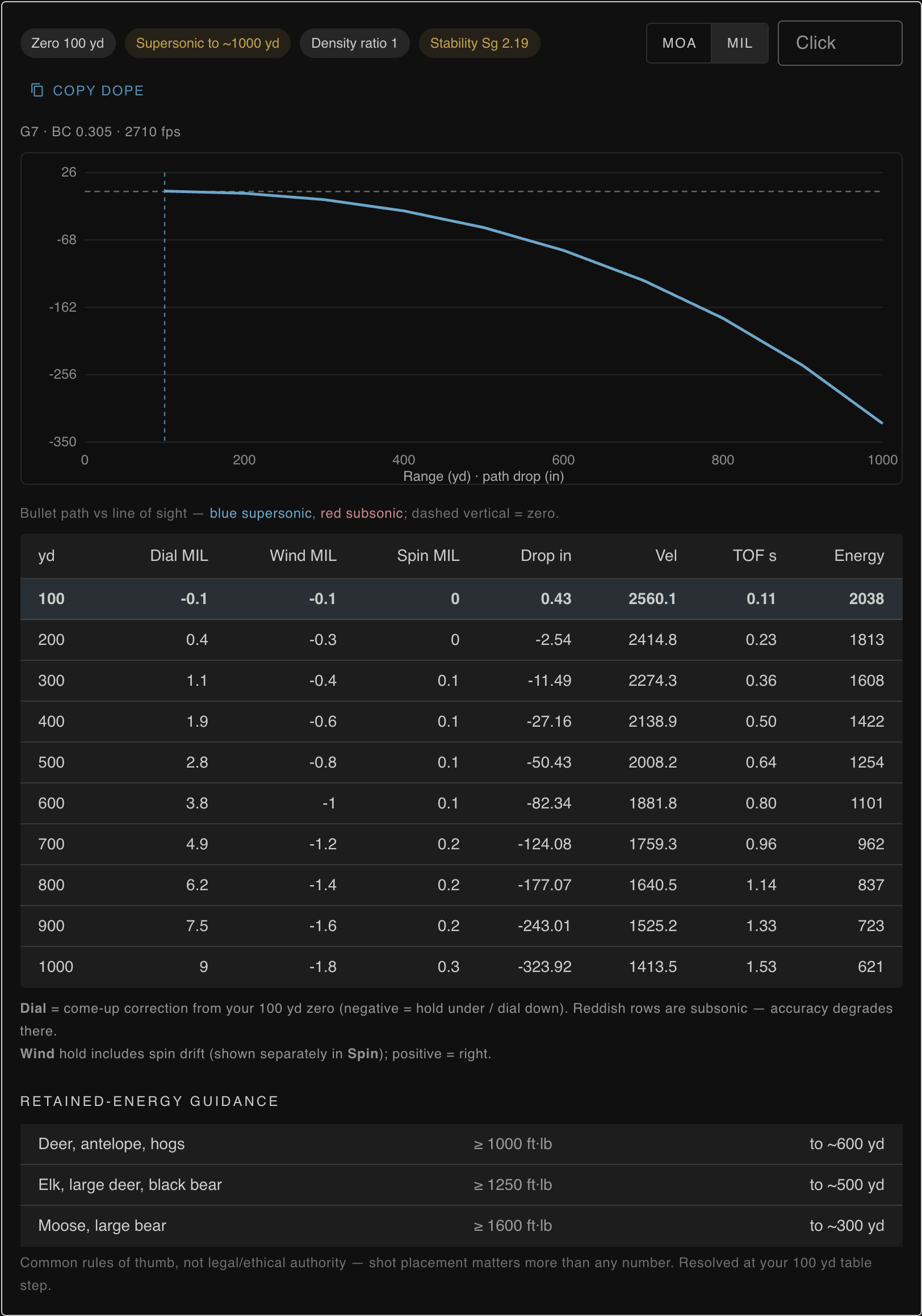
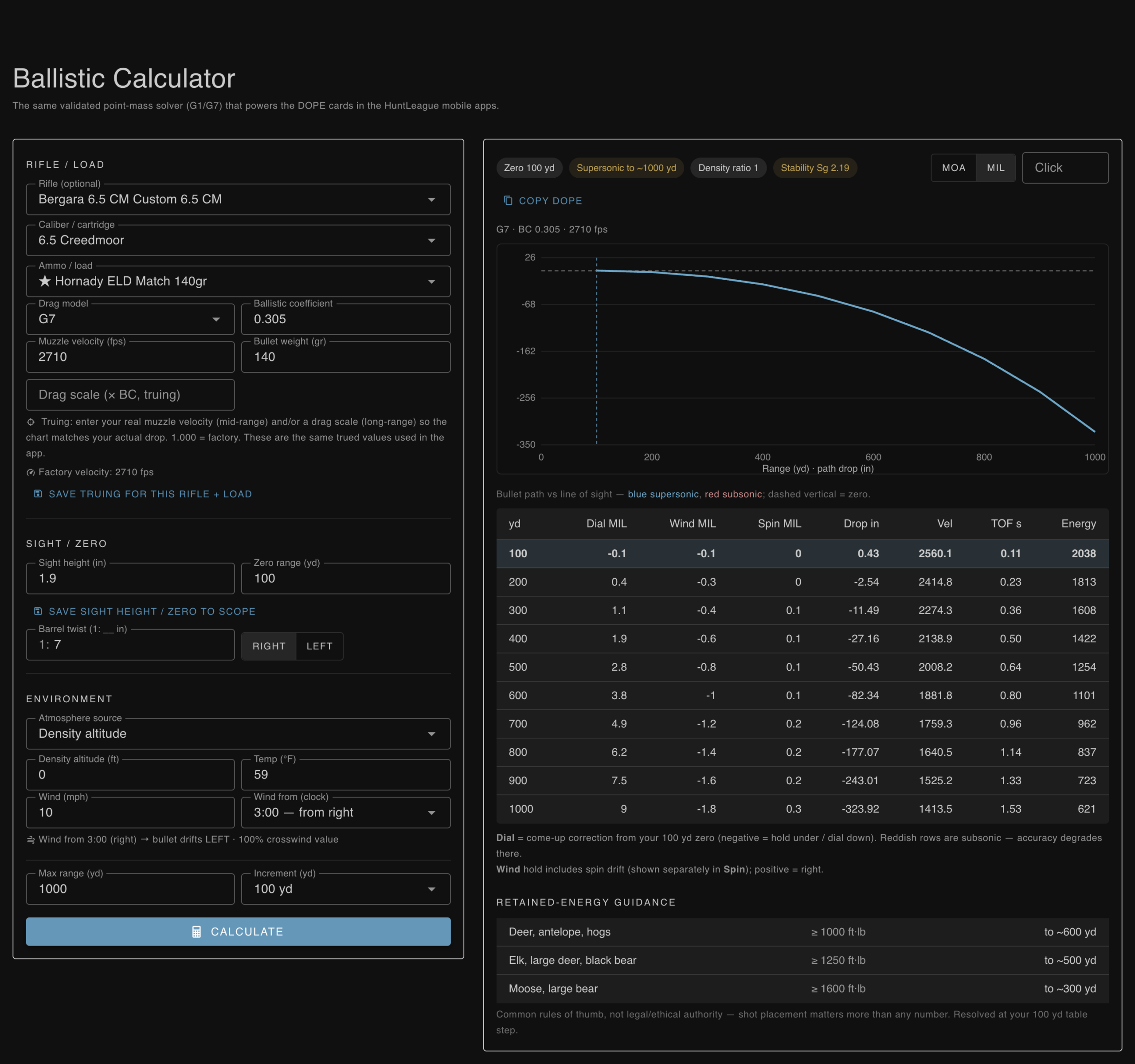
Here is the same rifle and load solved at sea level and at 7,500 ft DA: at 1,000 yards the dial drops from 9.0 MIL to 7.9 MIL, the bullet arrives about 240 fps faster, and deer-class energy stretches from roughly 600 to 800 yards. Thinner air is faster air.
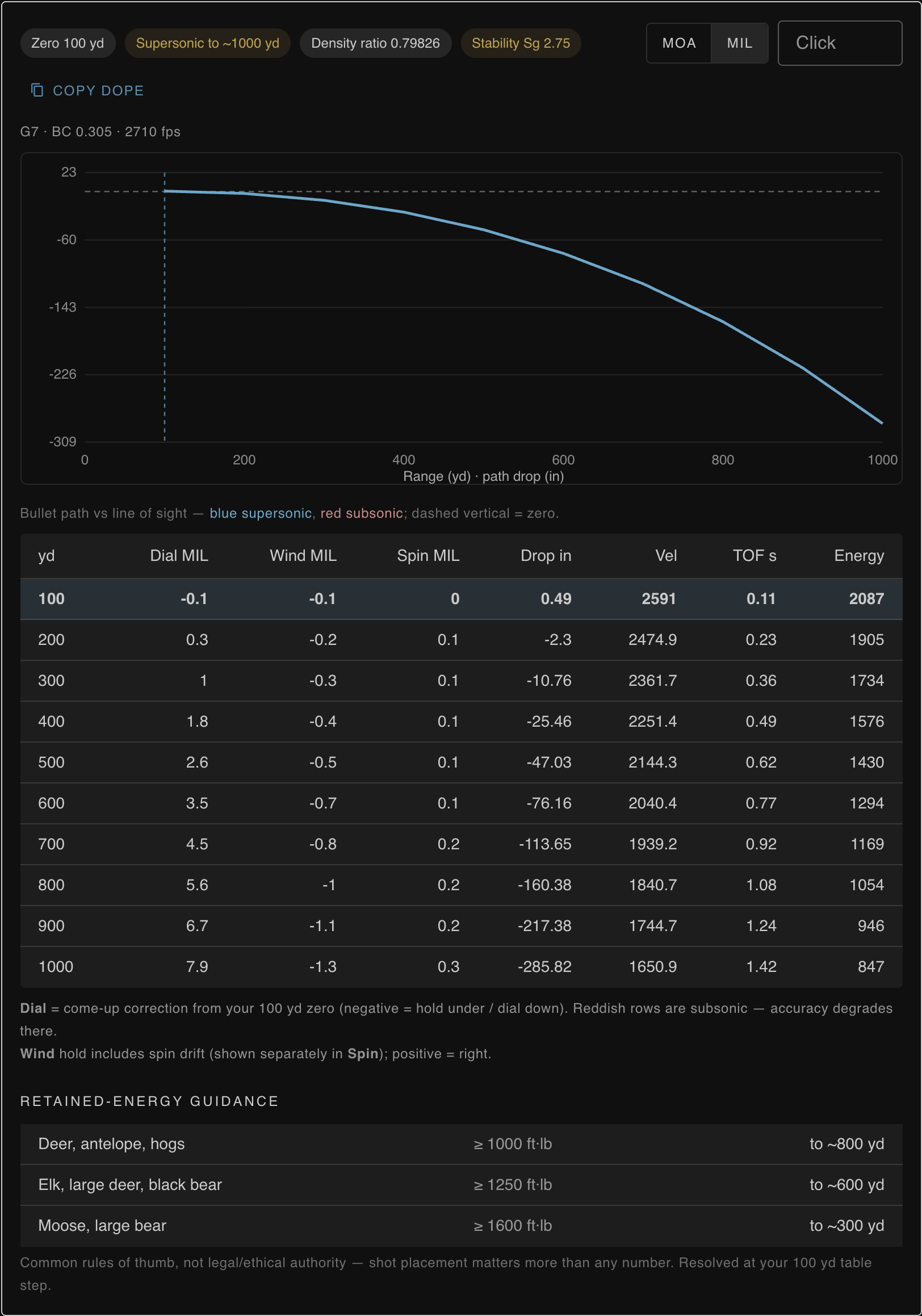
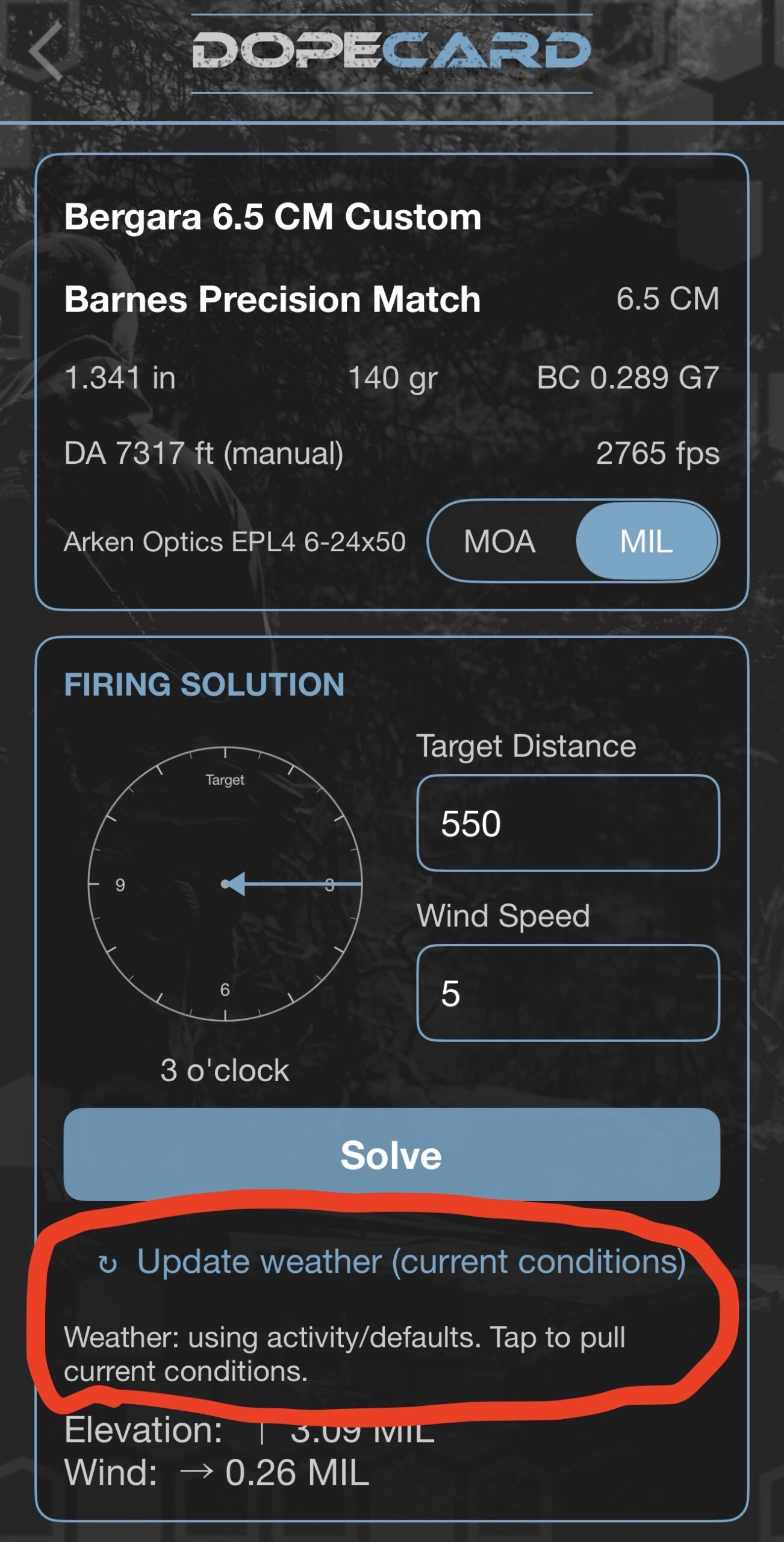
HuntLeague resolves DA in layers, using the best information available: enter it manually if you carry a Vortex ACE, Kestrel or wind meter; tap Update Weather and the app pulls current conditions from the closest weather station, corrected to your actual GPS elevation; and if you are completely offline, it falls back to a standard-day DA from your device’s GPS elevation — so the solution is never built on sea-level air unless you are actually at sea level.
Aerodynamic Jump (wind correction most hunters have never heard of)
A crosswind does not just push your bullet sideways. In the first few feet of flight, the wind shoves the bullet’s nose slightly off-line, and because the bullet is gyroscopically stabilized it responds at 90° to that push — vertically. That is aerodynamic jump: a wind-caused elevation shift. With a right-hand twist barrel, wind from your right pushes impact high; wind from your left pushes it low.
For a typical 6.5 Creedmoor match load it is worth about 0.1 MIL per 10 mph of full-value crosswind — small at 300 yards, a miss at 900. HuntLeague models it with Bryan Litz’s published formula, using your actual stability factor and bullet length, and folds it into your elevation dial automatically. You read one number; the physics is already in it.
Spin drift — the slow sideways creep
That same gyroscopic stability makes the bullet’s nose ride slightly to the side of its flight path, and it slowly surfs in the direction of its spin — right for a right-twist barrel, left for a left-twist. Spin drift barely exists inside 400 yards, then grows fast: for the 140 gr ELD Match above it is about 0.3 MIL at 1,000 yards — a full target-width at match distances.
HuntLeague computes it from your barrel’s twist rate and twist direction (both saved on your rifle in the Safe), shows it in its own Spin column so you can see it, and includes it in the total wind hold so you do not have to add it yourself.
Setting it up: two minutes in your Safe
Everything the solver needs lives in the HuntLeague Safe — enter it once, and it follows the rifle everywhere.
- On the rifle: barrel twist rate (e.g. 1:8) and twist direction (Right/Left), sight height over bore, and zero range.
- On the scope: adjustment type (MOA or MIL) and click value — so dials come back in your clicks.
- On the load: pick your ammo from the built-in factory library and the ballistic coefficient (G1/G7), bullet weight, and factory velocity fill themselves in — or type your handload’s numbers.
- Chronograph velocity: save your measured muzzle velocity per rifle + load. Your barrel is not the factory test barrel, and the solver will always prefer your real number.
Enter your rifle once. Get real firing solutions everywhere you already hunt, shoot, and log — phone, match clock, or desktop, with or without signal.
HuntLeague Ballistics is live now in the HuntLeague app on iOS and Android and on the web portal. Open your Safe, fill in your rifle, and tap the HL BALLISTICS icon in the upper right corner — your first DOPE card is about two minutes away.
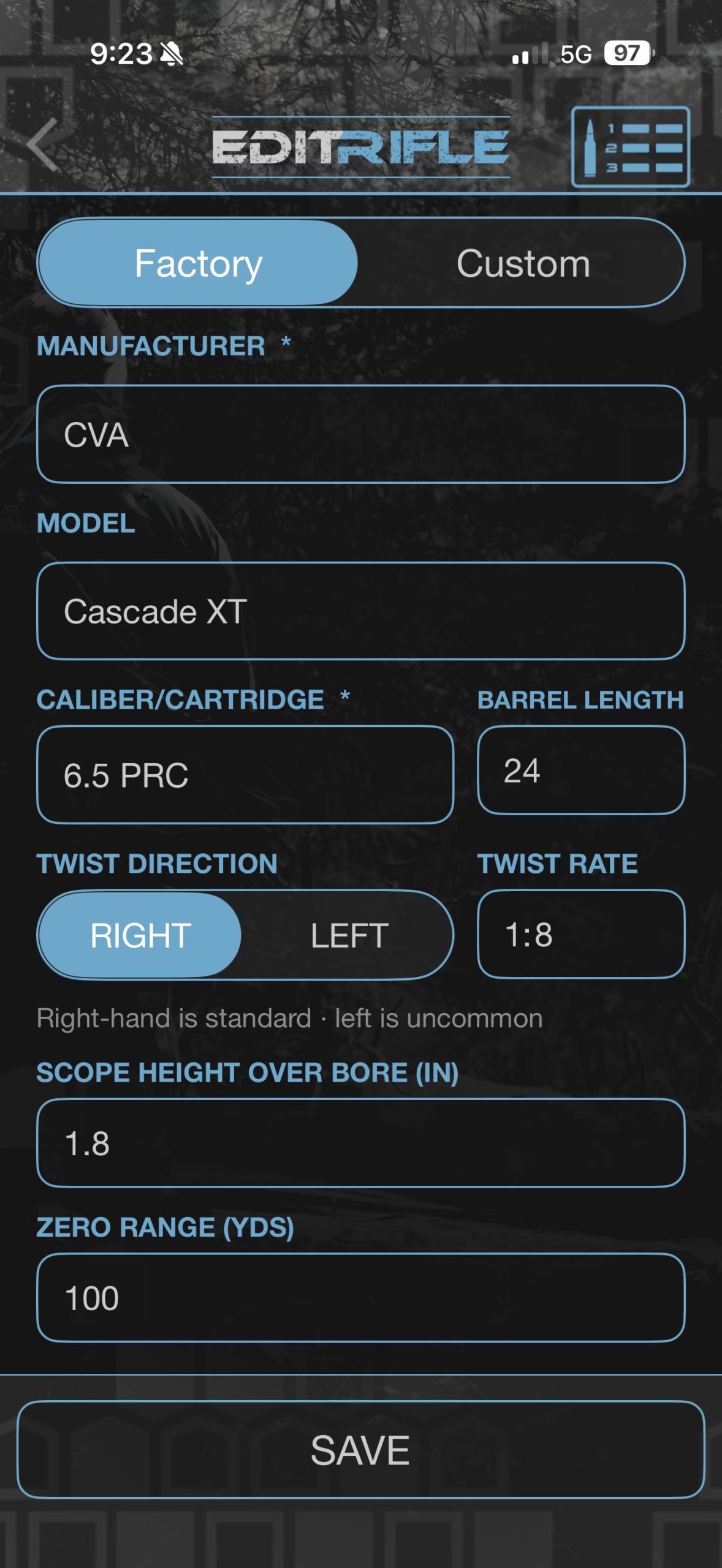
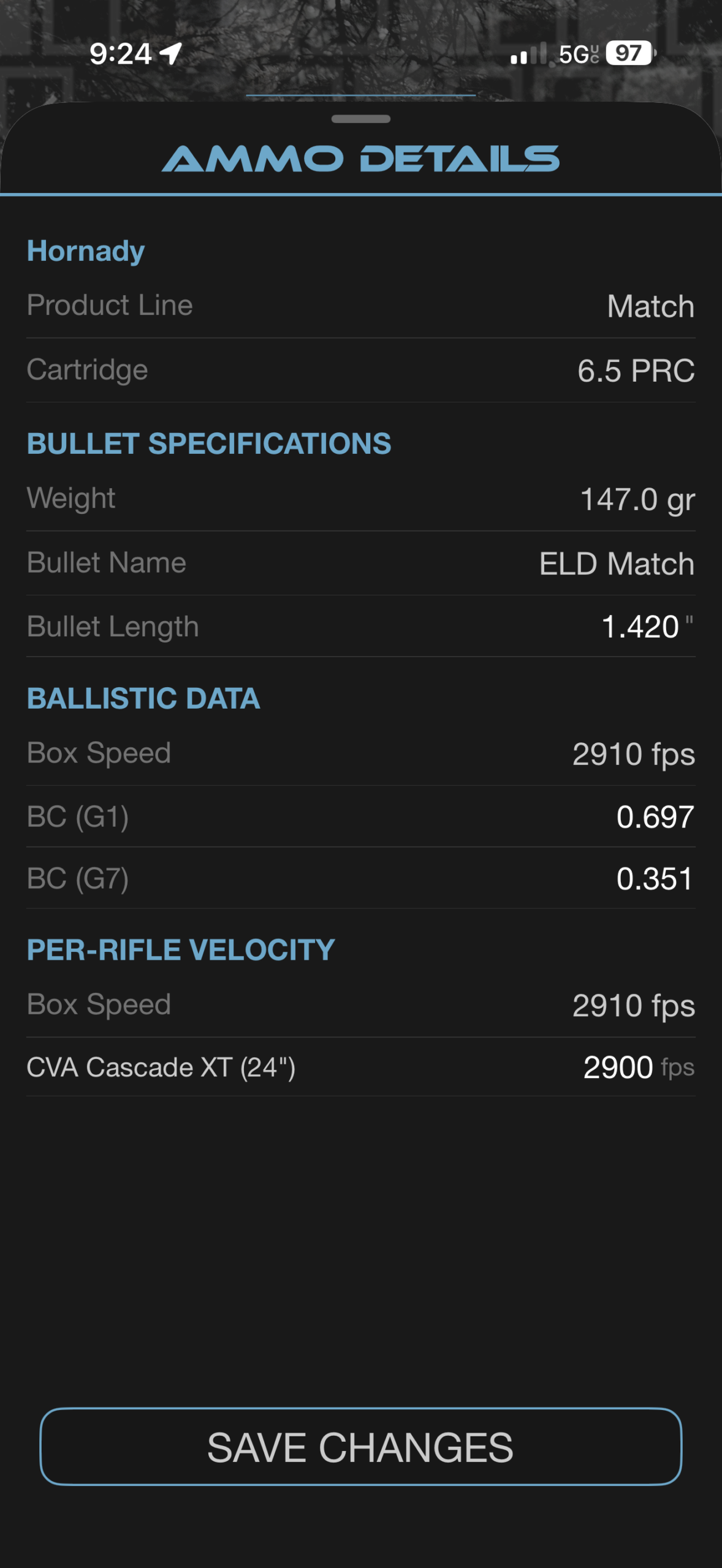
Tap the HL BALLISTICS Icon — it opens the full DOPE card for that rifle right from the Safe, no active hunt required. And if the solver is missing something it truly needs, the DOPE icon wears a red badge with the count of missing inputs; tap it and the app walks you through filling the gaps on one screen, saving each answer straight back to your Safe.
Seeing it in the field
On any active rifle hunt — and on every NRL Hunter match screen — the Ballistics icon sits in the upper-right of the header. Tap it and your DOPE card opens with your rifle, your load, and the current atmosphere already loaded. Switch MOA/MIL on the fly, get a single-shot firing solution for an exact distance, or scan the full table.
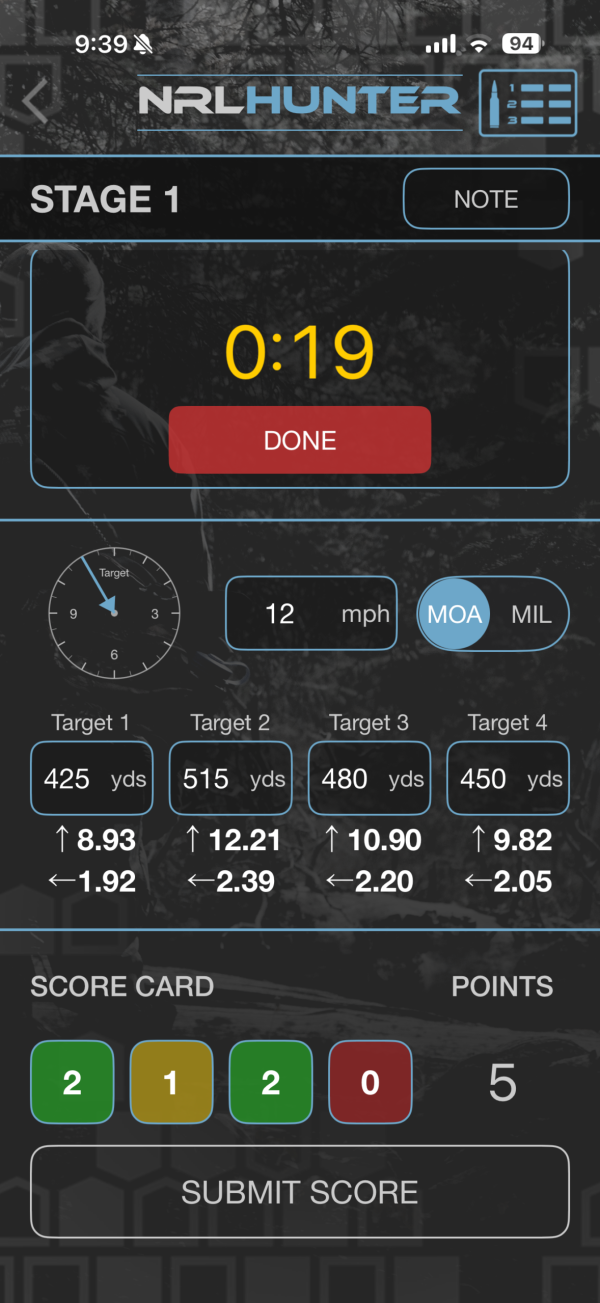
In an NRL Hunter stage it goes one step further: enter the target distances and your wind call on the stage clock screen, and the dial and hold for every target render inline — solved with the match-day density altitude and your per-stage wind, with aerodynamic jump and spin drift already folded in. When you finish the match, HuntLeague saves a ballistic snapshot of exactly what the calculator was using — rifle, load, BC, velocity, and atmosphere — with the match log, so you can review it later on the web portal.
True it to your rifle
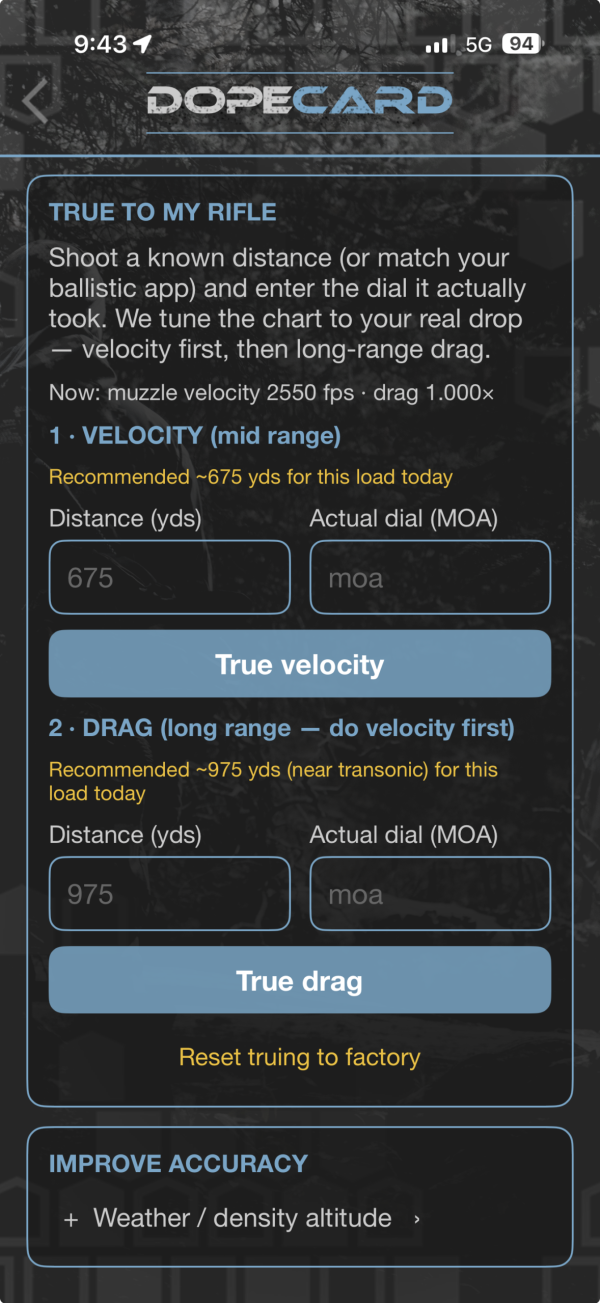
No solver survives first contact with your barrel unchanged — so HuntLeague includes two-stage truing, the same approach the professional solvers use. Confirm your actual drop at mid-range and the app trues your muzzle velocity; confirm again near the transonic zone and it trues the drag scale. Both corrections save per rifle + load and follow you across the app, the NRL screens, and the web portal.
And a full-size version on the web portal
The same calculator lives on the HuntLeague web portal under Ballistics — big-screen DOPE built from the same Safe data and the same solver. Pick a rifle and everything you entered in the app is already there. Generate the table at 5-, 10-, 25-, 50-, or 100-yard steps, flip between MOA and MIL, and Copy DOPE to paste into a range card or group chat.
Enter your rifle once. Get real firing solutions everywhere you already hunt, shoot, and log — phone, match clock, or desktop, with or without signal.
HuntLeague Ballistics is live now in the HuntLeague app on iOS and Android and on the web portal. Open your Safe, fill in your rifle, and tap HL BALLISTICS — your first DOPE card is about two minutes away.